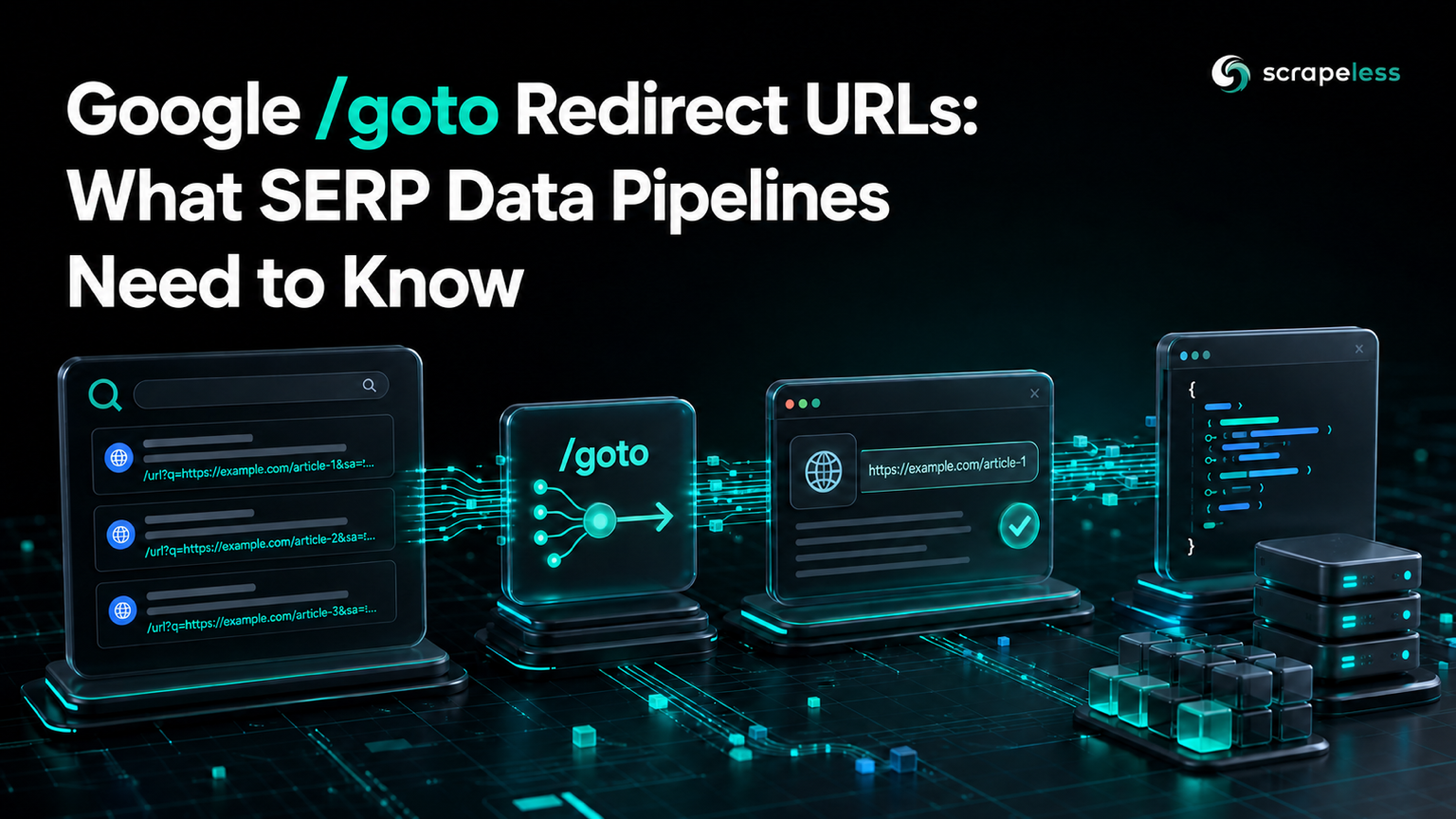
Google /goto Redirect URLs: What SERP Data Pipelines Need to Know

Lead Scraping Automation Engineer
TL;DR:
- Google
/gotolinks put an intermediary URL between a search result and its destination. A parser that reads only the result-pagehrefmay collect a Google URL instead of the publisher URL. - The visible result and the ranked page do not change simply because the link is wrapped. The practical change is in how automated SERP systems identify, validate, and store destination URLs.
- Rank tracking, domain analysis, crawling, and search-grounded AI are the workflows most exposed. Each depends on a usable final destination rather than a transport link.
- Scrapeless handles Google
/gotoredirects within its Google Search API workflow. Customers can continue using structured search output without adding a separate redirect-resolution layer.
Google Search result links are no longer always direct publisher URLs. A result can expose a Google-hosted /goto address that forwards the click to the page represented by the result. For a person searching in a browser, the interaction still feels familiar. For a SERP data pipeline, the change breaks a common assumption: the link in the markup may not be the URL the system actually needs.
This article explains how Google /goto redirect URLs change SERP collection, which workflows are affected, what a stable URL contract should contain, and how Scrapeless keeps the change from becoming customer-side maintenance.
What Changed in Google Search Result URLs?
Google can now deliver a result link through a google.com/goto intermediary instead of exposing the publisher destination directly in the page markup. The result card can still describe the same page, but the collected href belongs to a Google host and must be interpreted as a transport URL.
The important boundary is between what was observed and what was reached:
observed_urlrecords the exact link exposed by the search result.redirect_chainrecords the locations seen during navigation.final_urlrecords the destination reached after the redirect is resolved.normalized_urlprovides a policy-based comparison form of that destination.
These fields should not be collapsed into one value. The observed URL is evidence of the search page at collection time; the final URL is the useful destination for most downstream work.
How Does a Google /goto Redirect Work?
A Google /goto link sends the client to an intermediate Google endpoint, which then directs the client toward the destination page. The redirect target should be obtained from actual HTTP or browser navigation rather than from assumptions about an opaque query value.
The HTTP Semantics specification defines how redirect responses can identify another URI through the Location field. A browser normally follows that instruction automatically. A SERP collector that reads only HTML attributes does not complete that navigation, so it sees the wrapper rather than the final resource.
Deleting /goto from a string does not solve the problem because the destination is not the remainder of the visible path. The system needs controlled resolution, URL validation, and preservation of the original search-result link.
The separation between resolution and normalization is equally important. Redirect resolution discovers where the link leads. URL normalization creates a comparison form after the destination is known. The URI generic syntax permits specific normalizations, but path and query meaning remain application-dependent. Lowercasing an entire path or removing every query parameter can merge pages that are genuinely different.
What Changes, and What Stays the Same?
The /goto wrapper changes how destination data is delivered, not necessarily which page the search result represents. Search users can still click a result and reach its landing page, while automated readers need to account for the extra transport layer.
What changes for SERP systems:
- The raw
hrefmay no longer be a publisher URL. - Domain extraction cannot rely on the observed link alone.
- Redirect resolution becomes part of destination validation.
- Request volume and latency can increase when every result is resolved separately.
- Historical datasets may alternate between direct and wrapped URL formats.
What does not need to change:
- Ranking positions can still be modeled from the result order.
- Result titles, snippets, and other structured fields remain separate from URL transport.
- The original observed link can still be preserved for audits.
- Downstream systems can keep using destination URLs when the collection layer resolves them first.
The change belongs near the collection boundary, where raw search data becomes a stable output contract. It should not become a custom patch inside every downstream application.
Who Is Affected by Google /goto Links?
Google /goto links mainly affect systems that read search-result markup programmatically and depend on direct destination URLs.
Rank tracking platforms
Rank trackers compare positions and landing pages over time. Alternating between an intermediary URL and a publisher URL can create a false page change even when position is stable.
SEO and market intelligence teams
Domain-level share of voice depends on the correct registrable domain. Grouping by the raw /goto host would misclassify results and make a delivery change look like a competitive shift.
AI and answer-engine pipelines
Search-grounded systems use SERP data to discover current sources. Final citations should point to publisher documents, while the observed link remains available for traceability.
Crawling and enrichment systems
Second-stage fetchers need a validated HTTP or HTTPS destination and an explicit state when it cannot be established. Sending wrappers downstream spreads URL interpretation across the pipeline.
Research datasets
Research datasets should append a resolution event and keep the raw observation intact rather than replacing historical values in place.
Start Scraping with Scrapeless
Power up your web scraping and automation workflow with Scrapeless!
Sign up today and get $5 in free credit — no credit card required.Claim your free credit now in the Scrapeless Dashboard.
Why Google /goto Links Increase Pipeline Work
Google /goto redirects turn destination extraction from a markup read into a navigation problem. Without collection-layer support, a system may need to resolve many links individually before it can build a clean ranking, domain, or citation dataset.
The added work appears in three places. First, each intermediate link needs network handling rather than a simple attribute read. Second, the returned location needs scheme, host, and response validation. Third, the final value still needs normalization under the team’s existing URL policy.
At production scale, the difference affects latency, connection volume, failure accounting, storage, and observability. Organic listings, sitelinks, images, videos, local packs, and other modules also do not share one universal link shape.
That is why a one-line replacement rule is fragile. A durable system classifies the observed link, resolves only when needed, records the outcome, and returns a stable destination field to its consumers.
How Scrapeless Handles Google /goto Redirects
Scrapeless handles Google /goto intermediary links within the Google Search API workflow. Customers receive usable destination URL data in structured search output, so they do not need to add a separate /goto resolver or redesign their existing collection workflow.
Scrapeless already resolves Google /goto redirect URLs for Google Search API customers. Contact the Scrapeless sales team for details.
The Google Search API parameter reference explains the available query controls, while the Google Search endpoint reference covers the request and response structure.
What Should a Redirect-Aware SERP Contract Store?
A redirect-aware SERP contract should preserve the collected link, the resolved destination, and the policy used to compare URLs. This keeps raw evidence separate from derived fields and prevents a delivery-format change from silently changing the meaning of a row.
| Field | Purpose |
|---|---|
observed_url |
Exact link captured from the search result |
redirect_chain |
Ordered redirect locations and statuses |
final_url |
Destination reached during resolution |
normalized_url |
Policy-based comparison form |
registrable_domain |
Domain-level aggregation key |
resolution_state |
Direct, resolved, blocked, timed out, or invalid |
resolved_at |
Time attached to the resolution event |
normalizer_version |
Policy version used for the comparison key |
Use a conforming parser for these transformations. The WHATWG URL standard defines browser-compatible parsing behavior for hosts, paths, ports, and queries. Regular expressions are a poor substitute for a URL parser because they tend to blur parsing, validation, and business policy.
The collection process should also distinguish direct links from wrapped links before resolution. Google’s crawlable-link guidance describes resolvable URLs in anchor href attributes, but a data consumer still has to label whether the observed URL is a destination or an intermediary.
Version the normalizer so derived fields can be rebuilt when parameter, fragment, or trailing-slash policies change, without rewriting the raw observation.
How Should Teams Validate Their SERP Data?
Teams should validate Google search result URLs across the exact surfaces their products consume. One desktop query cannot establish a universal rule for every vertical, market, device, and session state.
| Dimension | Suggested cases | What to compare |
|---|---|---|
| Vertical | Web, news, images, shopping, local | Raw link format and destination field |
| Market | Production countries and languages | Host, redirect path, and final domain |
| Device | Desktop and mobile profiles | Markup and navigation behavior |
| Session | Signed out and approved signed-in tests | Link exposure and consent flows |
| Result type | Organic, featured, video, sitelink | Parent-child URL relationships |
Keep a small fixture for each important case with query inputs, raw result fields, resolution state, final URL, and normalized key. Compare it whenever the parser, resolver, or schema changes so collection differences are caught before they reach reporting or citations.
Bottom Line
Google /goto redirect URLs change the transport layer of search results. They do not need to become a customer-side emergency. A sound SERP pipeline preserves the observed link, resolves the destination before normalization, and exposes a stable field contract to downstream systems.
Scrapeless has already incorporated handling for this change into its Google Search API workflow. Customers can keep collecting structured search results without building a new resolution service or changing the applications that consume those results.
Build a Redirect-Aware SERP Dataset
Join the Scrapeless community on Discord or Telegram. Open the Scrapeless Dashboard to test structured Google Search data against your URL contract.
FAQ
Q: What is a Google /goto redirect?
A Google /goto redirect is an intermediary Google-hosted link that forwards a search-result click toward its destination page. It should be stored separately from the final publisher URL.
Q: Does a /goto link mean the ranked page changed?
No. A wrapped link changes how the destination is delivered in the result markup; it does not by itself prove that the ranked page or position changed.
Q: Should a pipeline decode the /goto query value?
No. The destination should come from controlled redirect or browser navigation, not an undocumented assumption about an opaque parameter.
Q: Which URL should be used for rank and domain reporting?
Use the validated final destination and derive the registrable domain from that value. Keep the observed search-result URL in a separate field for audits.
Q: Does Scrapeless handle Google /goto redirect URLs?
Yes. Scrapeless handles Google /goto intermediary links within its Google Search API workflow and returns usable destination URL data in structured output, without requiring customers to add a separate resolver.
Q: Do existing Scrapeless customers need to change their workflow?
No. Existing customers can continue using the structured Google Search API output; Scrapeless maintains the /goto handling inside the service.
At Scrapeless, we only access publicly available data while strictly complying with applicable laws, regulations, and website privacy policies. The content in this blog is for demonstration purposes only and does not involve any illegal or infringing activities. We make no guarantees and disclaim all liability for the use of information from this blog or third-party links. Before engaging in any scraping activities, consult your legal advisor and review the target website's terms of service or obtain the necessary permissions.